

 See My Latest Article on HelloNation
Why does play matter for brain development?
Play is a primary way children practice thinking, moving, communicating, managing emotions, and connecting with other people. It is not separate from learning; for young children, play is often the setting where learning happens most naturally.
During play, children make choices, test ideas, notice patterns, solve problems, and adjust their behavior. These experiences help strengthen brain networks involved in attention, memory, language, movement, and self-regulation. The American Academy of Pediatrics identifies developmentally appropriate play as a way to support cognitive, social-emotional, language, physical, and executive-function skills. ([publications.aap.org](https://publications.aap.org/pediatrics/article/142/3/e20182058/38649/The-Power-of-Play-A-Pediatric-Role-in-Enhancing?utm_source=openai))
For families in Pickerington, OH, play can happen indoors during cold or rainy weather, outside during warmer months, or in ordinary household routines. Expensive equipment is not required. A child’s interest, active participation, and relationship with a responsive adult matter more than the price or appearance of a toy.
How does play strengthen executive function?
Play gives children repeated practice with three abilities that support later learning and daily independence:
- Working memory: holding information in mind, such as remembering the rules of a game
- Inhibitory control: pausing, waiting, or resisting an impulse
- Cognitive flexibility: changing plans, trying another strategy, or seeing a situation from someone else’s perspective
These abilities are often called executive function. A child uses them while building with blocks, pretending to run a restaurant, waiting for a turn, or changing a game when another child suggests a new rule.
A simple matching game may require a child to remember which cards have been seen. A pretend grocery trip can involve planning, sorting, counting, and using language. A game such as “freeze dance” combines movement with listening and impulse control.
The Center on the Developing Child at Harvard University describes playful activities as opportunities to practice focusing attention, strengthening working memory, and developing basic self-control. ([developingchild.harvard.edu](https://developingchild.harvard.edu/resources/handouts-tools/brainbuildingthroughplay/?utm_source=openai))
What types of play support development?
Different kinds of play exercise different areas of the developing brain. Children benefit from a mixture rather than one specific category.
Sensory and exploratory play helps children learn through touch, movement, sound, and visual observation. Infants may reach for a soft object, shake a rattle, or watch a caregiver’s face. Toddlers may pour water between containers or explore how objects fit together.
Physical play develops balance, coordination, body awareness, strength, and motor planning. Running, climbing, jumping, dancing, carrying objects, and playing with a ball all provide useful feedback to the brain and body. In colder seasons, indoor movement games can offer similar opportunities.
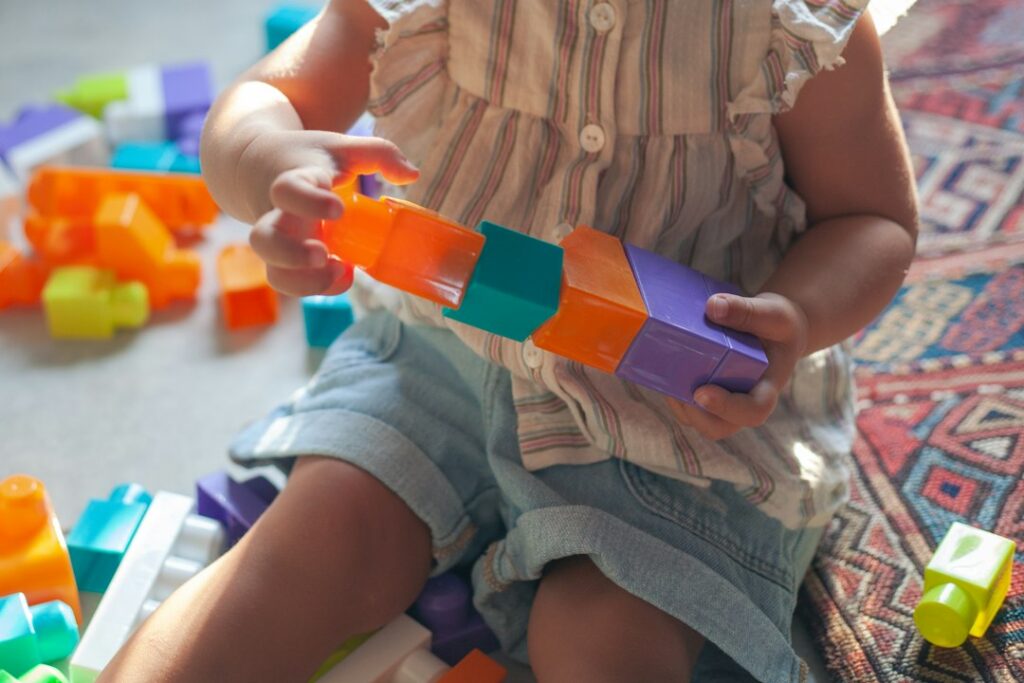
Constructive play includes building, drawing, assembling, arranging, and making. Blocks, cardboard boxes, paper, recycled containers, and household objects can support spatial reasoning, creativity, and persistence.
Pretend play supports language, planning, emotional understanding, and flexible thinking. When a child pretends to be a teacher, veterinarian, cook, or superhero, the child is practicing roles, sequencing events, and considering what another person might think or feel.
Social play teaches negotiation, cooperation, turn-taking, repair after conflict, and communication. Children do not automatically know how to share ideas or resolve disagreements; play provides repeated, meaningful practice.
Games with rules help children manage frustration, remember expectations, wait, and accept that outcomes may not always go their way. Rules should be simple enough for the child’s developmental level and flexible enough to preserve enjoyment.
Is free play more valuable than adult-directed activity?
Free play and guided play both have value. Free play allows children to lead, explore, and develop their own ideas. Guided play adds a light layer of adult support without taking control away from the child.
An adult might place several containers and spoons near a toddler and ask, “Which one holds more?” The child remains in charge of exploring, while the question encourages observation and comparison. During block play, an adult might wonder aloud, “How could we make the bridge stronger?” rather than building the solution.
Too much correction can reduce curiosity. If an adult demonstrates the “right” way to use every toy, a child may have fewer opportunities to discover alternative uses. The goal is not to leave children unsupported, but to follow their interests, offer language, and provide help when frustration becomes overwhelming.
Helpful adult behaviors include:
- Watching before stepping in
- Describing what the child is doing
- Adding words for emotions, actions, shapes, or positions
- Asking occasional open-ended questions
- Allowing safe mistakes and repeated attempts
- Joining the child’s pretend scenario without directing every detail

How does play support emotional and social development?
Play gives children a safe way to express feelings and rehearse difficult experiences. A child may use dolls to act out a first day of school, create a story about separation, or repeatedly replay a frightening event in a more manageable form.
Shared play also strengthens relationships. Back-and-forth exchanges—such as smiling at an infant, copying a toddler’s sounds, or taking turns adding to a story—teach children that communication is mutual. These interactions can help children feel understood and supported.
The AAP notes that warm, responsive play may help buffer stress by creating safe, stable, nurturing relationships. Play does not eliminate serious stressors, but dependable connection during ordinary activities can help children return to a calmer state and remain available for learning. ([publications.aap.org](https://publications.aap.org/pediatrics/article/142/3/e20182058/38649/The-Power-of-Play-A-Pediatric-Role-in-Enhancing?utm_source=openai))
How much play does a child need?
There is no single number of minutes that defines a healthy play experience. Children need daily opportunities for movement, exploration, social interaction, quiet concentration, and imaginative activity. The balance changes with age, temperament, health, weather, family schedules, and access to safe spaces.
For infants, play may consist of floor time, reaching, looking at faces, songs, and responsive back-and-forth interaction. Toddlers often need frequent chances to move, imitate, sort, carry, and pretend. Preschoolers benefit from longer stretches of imaginative, constructive, physical, and social play. School-age children still need unstructured time, even as academic and organized activities increase.
In a community with changing weather, area households may need to alternate between outdoor and indoor options. A short walk can become a scavenger hunt for colors or shapes. Snow, leaves, puddles, and sticks can provide natural materials for observation and imaginative play when conditions are safe. Indoors, pillows can become stepping stones, paper can become a map, and ordinary chores can become sorting or matching games.
Can play reveal developmental concerns?
Play can provide useful information about how a child communicates, moves, solves problems, and interacts, but it should not be used as a stand-alone test or diagnosis. Children develop at different rates, and interests vary.
Families may wish to discuss concerns if a child loses previously acquired skills, shows persistent difficulty using play to communicate or engage, has significant challenges with movement or coordination, or is not meeting several expected developmental milestones. The CDC explains that milestones include how children play, learn, speak, act, and move; its age-based resources can help families organize observations before discussing them with a qualified healthcare or developmental professional. ([cdc.gov](https://www.cdc.gov/act-early/milestones/index.html?utm_source=openai))
The most useful play environment is usually one that is safe, relational, and flexible. A child does not need constant entertainment or a perfectly planned activity. Time to explore, move, imagine, communicate, and try again gives the developing brain repeated opportunities to build the skills used in school, relationships, and everyday life.